
Love at First Launch is out now!
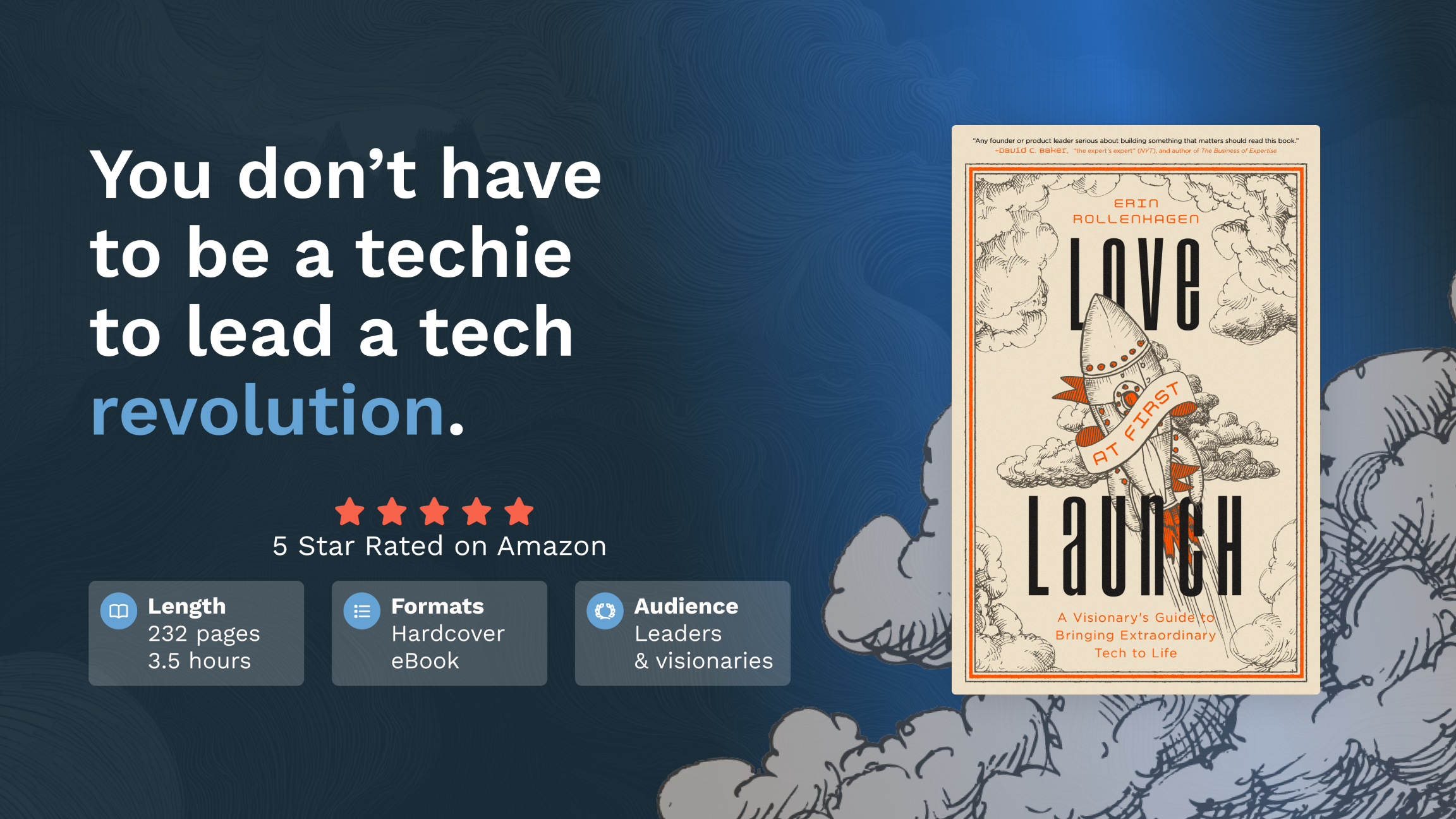
My second book Love at First Launch: A Visionary’s Guide to Bringing Extraordinary Tech to Life is out now in hardcover and e-reader formats. Available on Amazon, Barnes & Noble online, Bookshop.org, and many other retailers. It’s an exciting moment and I’m thankful for everyone who had a hand in the production of this book.
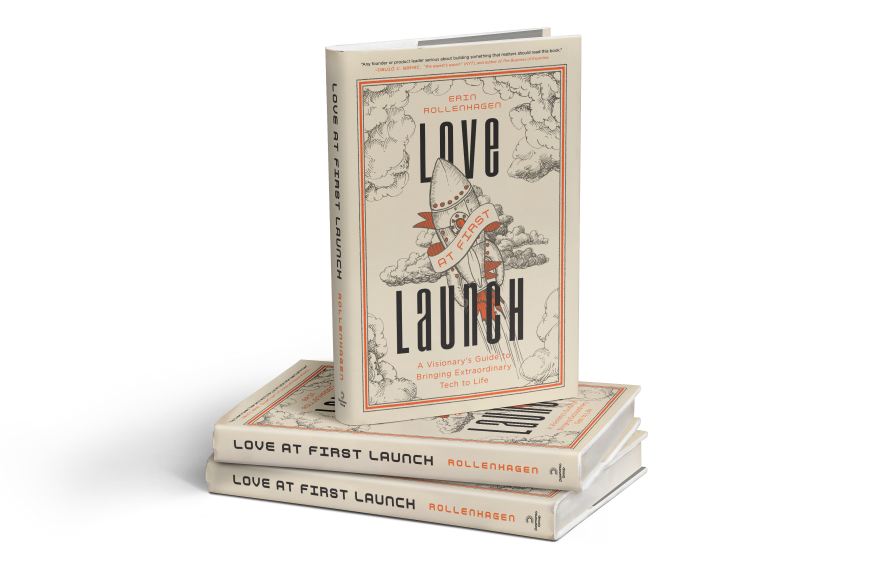
I am so grateful for the positive early reviews and feedback. This week I thought I’d touch on a few of the topics in the book so you can decide if it’s something you’d like to read.
The book came out of the frustration I’ve had over the years both being a founder myself and working with leaders and founders at other organizations through hundreds of tech launches. I began to notice that the things that were hard weren’t always the things people expected to be hard. And I also realized that if we could help people navigate those hidden tests, we could increase their chances of success.
Love at First Launch is my attempt to demystify the process and shed light on the unexpected keys to building something that matters—including the ones that live inside the leader.
This is the opening of the first chapter. If you want more, it’s out now.
Looking back on the beginning of a quest to create a great technology product, you can invariably pinpoint the moment when the idea took root, but not the moment before that. This is because at the very second when the idea sparks, your personal timeline will forevermore be divided into Before Idea, a dreary and meaningless time, and After Idea, the point when everything snapped into high definition.
And who would want to remember the Before, when the After is so much more vivid?
A great tech product begins not with a goal to raise profits 3% in the fourth quarter. It begins with a visionary leader, probably you, who has a gnawing feeling that something isn't right with your own corner of the universe, but it could be. It starts with the conviction that what comes next can be better than what has come before. When the "better" is a great deal better, and when the change happens quickly, it can profoundly alter how we live, work, think and feel. Concepts like AI, smartphones, cryptocurrency, even things we take for granted like navigation and spell check, all began with a visionary who believed that tomorrow could be dramatically better than today, and that they could be the one to turn the tides.
This is the dream of the visionary, and this is how a revolution starts.
And so you, our fearless revolutionary with the big vision, embark. The path before beckons, smelling of crushed grass and new beginnings, and you cannot deny the call. In the beginning, you stride forward alone, armed with spreadsheets, coffee, and a level of enthusiasm bordering on zealotry. But you do not stay alone for long. Because this is a monumental quest, because the results of this quest will be a true revolution for those who use your product, because this product matters, others can feel the pull too. You begin to gather allies along the way who believe in your vision. These people pick up the banner and take on tasks and goals, and as their energy begins to fuel the work, this smoldering ember of an idea begins to glow brighter and brighter. The revolution has momentum.
But the path is winding, and not everyone that your intrepid band of revolutionaries will encounter on this road is an ally. Your party has barely left sight of home when they begin to weather trials and setbacks. At first, those setbacks will be minor annoyances and your team will press onward. But for some would-be revolutions, the obstacles become too daunting. The operational issues, the data problems, the compliance reviews, the security challenges—they all take a piece of the dream. Disappointment after disappointment begins to smother that ember, especially in you, the founder.
This doesn't happen all at once. It happens almost imperceptibly, meeting by meeting, like the sole of a leather shoe that the asphalt abuses a bit with every step until it is rough and spongy. It shows in short tempers and lengthy pauses in conversation. It shows in the clench of a jaw and the inward curling of shoulders as the pace of your march slows. And one day, the group's footsteps cease and do not start again.
That is how a revolution dies.
Does this sound familiar? By the time you’re encountering this book, you may have already experienced something like this. You may have already attempted to launch a revolutionary platform or app into the world, only to be shunted through the gauntlet, weathering blows from all sides. You may have watched security take their shot, with compliance close on their heels. Sales and Operations each had their say. Every department had valid criticisms and concerns. And each required an accommodation of some sort, small by itself, but when multiplied across the entire organization, the job was done.
By the end of this experience, your dream felt as though it had been shredded, or at least downgraded to the least provocative version of itself. Far from being a revolution, this was just another app. Even if you nail the features and benefits you envisioned through all that regulatory red tape, somehow you’ve led a lackluster launch that was nowhere near magnetic enough to draw people in and keep them there.
The founder is left wondering what happened. How did the vision go so far astray?
How did the team expend so much effort for such an underwhelming result? Amid all of the thousands of details that go into a tech launch, there’s a fundamental truth that tends to get buried along the way: most of what you will ever accomplish with a successful technology product can be summed up in these five words: it makes people feel better.
Maybe you make them feel better by simplifying something complex, taking away a worry, or making them feel organized or smarter. Maybe you give them an outlet for creativity so they feel fulfilled or help them save money so they feel more secure or educate them on their journey so they feel less alone. Perform the action without evoking the feeling and you haven’t done much (people who have saved money but are still equally stressed haven’t made a fundamental change to their lives). By contrast, if you could make someone feel less alone, more organized, more on top of things, even if you made no changes at all to their tangible world, you’ll have done something valuable.
As founder of People-Friendly Tech, I've led a team responsible for over 200 successful tech launches, from startups to big brands. Our team has designed, built and scaled tech that's led to over a dozen exits, funding raises and acquisitions. Our products have achieved 5-star app ratings, been featured in TechCrunch and won national and international awards. And through it all, one thing has remained the same: it comes down to the emotional element.
Feeling is the heart of everything that matters. What happens at the peak of a great movie? You cry (or maybe just tear up a little if you're the stoic type).
What happens when you experience big life moments, like the birth of a child, a college graduation, a major career accomplishment? You are overcome by emotion.
Maybe you cry, maybe you laugh. But you feel something deeply.
We intuitively seek out the experiences that make us feel because they mean something to us. They remind us that our life has purpose and snap us out of the doldrums of doom scrolling.
This is where you come in. People will choose some way to chase real feelings, with or without you. Many will use technology to do it. They will scroll TikTok videos of jump scares. They will pick political fights with strangers on social media. They will shop obsessively, hoping to finally feel good enough.
These behaviors highlight a fundamental truth: while at first, we appreciated computers for their speed and accuracy, what people most want most from technology now is for it to be a little more like us. To have some heart. To respond to us in emotionally intelligent ways. To provide a nudge of compassion, hope or even inspiration. In short, to help us feel something.
Your success at creating impactful technology products depends largely on your ability to recognize this human desire to feel something, and find a way to fulfill it in a skillful way. The products that do this successfully are the remarkable few that cut through the haze of thousands of other messages to do something extraordinary: move people.
Make no mistake–emotion is a powerful tool and it can be used toward your audience’s betterment or its detriment. Like all revolutionaries, you must be cautious to stay on the right side of history, and use these tools toward a worthy goal. I believe you will. Of the hundreds of would-be tech revolutionaries I’ve talked to, all but a handful had their audience’s best interest at heart.
There is hope. You don’t have to take the painful path to a watered-down product. Your journey as a visionary will never be obstacle-free, but it can be fulfilling and you can succeed. But first, you have to get unshakably clear on the fact that it’s the emotion you drive (or fail to drive) that determines your success.
In this book, I will walk you through how to frame your quest for maximum impact, how and when to recruit crucial allies along the way, how to approach design and implementation to inspire the right emotions, considerations for integrating AI, a framework for a winning roadmap, and of course, the moment of launch. You'll understand how to lead a team through this time with confidence, vision, and maintaining your own energy and motivation, all while releasing a product that lives up to the initial vision—a product that inspires love at first launch.
5-star rated Love at First Launch: A Visionary’s Guide to Bringing Extraordinary Tech to Life is out now in hardcover and e-reader formats. Available on Amazon, Barnes & Noble online, Bookshop.org, and many retailers.